Kreston BSG
June 10, 2021
June 10, 2021

May 19, 2021
Losses in a limited-risk entity pursuant to the OECD Guidance on the Transfer Pricing Implications of the Covid-19 Pandemic
By Guillermo Narvaez, Tax Partner at Kreston FLS Mexico
The OECD guidance on the transfer pricing implications of the Covid-19 pandemic (referred to as the “Guidance”) was issued in December 2020. The idea was to give light to taxpayers and tax administrations on what to do about intercompany operations and how to apply the methodology of transfer pricing determined in the OECD TP Guidelines (“OECD TPG”) due to ‘fact patterns that may arise commonly in connection with the pandemic’.
There is a permanent discussion in transfer pricing related to ‘limited risk’ distribution operations and how to deal with this kind of transaction. A point to stress is whether a limited-risk distribution business could afford losses or these businesses are not ‘entitled’ to generate them.
There is neither a rule in the OECD TPG nor the Guidance related to losses generated by limited-risk distribution operations. Moreover, the term ‘limited risk’ is not defined in the OECD TPG. However, what is expected is that distributors with low risks have profits regularly and if losses are generated these should be part of an isolated fact not frequently repeated; however, this is only convention. When a subsidiary has full support from its related parties to make the distribution of products with moderate risks, the least expected thing is to deal with risks that could finally drive operating losses.
The fact is that a limited-risk operation can indeed generate losses, and this matter should not be a concern for the taxpayer nor the tax authority as long as the risks associated with the distribution operation and borne by the distributor, including the financial risk, are assumed by the latter.
If the terms of the agreement between related parties were those that independent businesses would have agreed and the negative operating result of the distribution operation is directly coming from applying such terms, the loss will probably make sense. Note that risks during a pandemic may be exacerbated. Nonetheless, the contractual terms should not be necessarily modified because of force majeure.
The Guidance is clear when it states that ‘It is important to emphasize that in the absence of clear evidence that independent parties in comparable circumstances would have revised their existing agreements or commercial relations, the modification of existing intercompany arrangements and/or the commercial relationships of associated parties is not consistent with the arm’s-length principle’.
Each case should be analysed to understand the background and effect of the pandemic on the specific operation accurately to get conclusions on what to do when a loss is incurred by a low-risk distribution operation.
Another matter is that the pandemic does not suffice to change the transfer pricing method applied in previous years. The Guidance is clear with regard to fostering the OECD TPG aims without modifying the arm’s length principle and its rules, all of them determined in the OECD TPG.
The Guidance is focused on giving light on what is needed to do in an extraordinary event like the pandemic suffered since the beginning of 2020 but in some cases with a very general view.
May 14, 2021
Practical application of the arm’s length principle in the context of the Covid-19 pandemic
By Carlos D’Arrigo, Transfer Pricing and Valuation Partner, Kreston BDM
In 2021 most taxpayers around the world would face an unprecedented challenge to reflect how their 2020 transactions compared to fair and open market values simply because in a crisis downturn like no other with disruptions and restrictions across almost every industry, how can you define what market conditions were fair? In the so-called phrase “business as usual”, how can you explain “usual”? We are not quite certain either but let’s try to find some answers.
On December 18, 2020, the 137 members of the Organization for Economic Co-operation and Development (“OECD”) Inclusive Framework on Base Erosion and Profit Shifting Action Plan (“BEPS”) released the Guidance on the transfer pricing implications of the COVID-19 pandemic (the “Guidance”) with the purpose of helping both taxpayers and tax administrations in reporting the financial periods affected by the pandemic in compliance with the arm’s length principle[1]. The guidance provides insights for the following four priority issues:
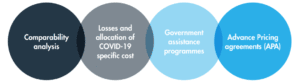
The Guidance recommends to first identify each specific cause that impacted taxpayers results and group them into three risk bubbles: Market Risk, Operational Risk and Financial Risk. The following chart intends to show a more comprehensive process flow:
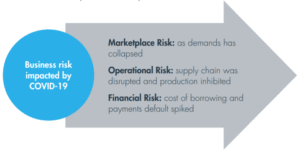
Identify specific cause
• Drop in sales volume and/or price
• Increase in material and labour cost
• Increase in overhead expenses
• Exceptional, non-recurring, extraordinary operational cost
• Decrease in capacity utilisation or economy of scale
• Increase in days inventory and obsolescence
• Increase in days Receivable
• Increase in interest rates and bank fee charges
Once specific causes are identified, the Guidance suggests addressing each of them on a case by case basis using the following sources of contemporaneous information to support the performance of a comparability analysis applicable for Fiscal 2020:
Guidance suggested source |
Our comments |
| Pre-COVID sales vs. 2020 actual | Be mindful when using new product/services data that could distort comparability, also marketing strategies to retain customers |
| Pre-COVID utilization vs 2020 actual | Economies of scales, cost structures and operating leverage, break-even analysis |
| Exceptional, non-recurring, extraordinary operational cost | Warehousing, logistics, overtime, transport, insurance |
| Government grants, subsidies, programs | Employee retention cost, rental and lease cost, tax waivers, deferral of contributions, interest |
| Macroeconomic data | GDP by country, sector or region, and trade association data can be helpful to confirm Pre-COVID sales vs. 2020 actual conclusions. Macroeconomics analyses might use data such as market share variation and drop in consumption, demand and other market metrics |
| Regressions | Regression analysis of variance analysis is more reliable to
predict variations when a large amount of data inputs are included; thus, it might be of limited help. |
| 2020 Budget vs 2020 real | Budget data is unlikely to be considered official data for controversy or court cases. |
Finally, Guidance made important remarks about comparability adjustments that are likely to be rejected by tax administrations including the following:
Guidance remarks |
Our comments |
| Prior global crisis comparison | Since COVID-19 is an unprecedented crisis like no other, using data from other global crisis, such as the 2008/2009 financial crisis, could lead to poor and superficial conclusions |
| Using Loss-making comparables | Although the Arm’s Length principle does not override the inclusion or exclusion of loss-making comparables[2] as long their inclusion/exclusion satisfy the comparability criteria, extra care should be taken when performing comparability analysis for fiscal 2020 ensuring that chosen comparables assumed similar levels of risk and that have been similarly impacted by the pandemic. |
| Intercompany renegotiations | Related parties that renegotiated certain terms in their existing agreements are advised to identify clear evidence that independent parties in comparable circumstances would have revised their existing agreements or commercial relations, otherwise, such modification of existing intercompany arrangements and/or the commercial relationships of associated parties is deemed to be considered not consistent with the arm’s length principle. Examples of fair renegotiation might include: renegotiate a contract to support the financial survival of any of the transactional counterparties, or to retain key customers, |
| Limited-risk arrangements | Consistency is key to support changes in limited-risk arrangements, for instance, a “limited-risk” distributor did not assume any marketplace risk Pre-COVID and hence was only entitled to a low return, but in 2020 argues that the same distributor assumes some marketplace risk and hence should be allocated losses, is expected to keep bearing such risk in 2021 and so on. |
| Force majeure adjustments | Taxpayers should carefully review existing intercompany arrangements when invoking a force majeure clause to ensure that: i) the arrangement actually includes a written force majeure clause, ii) if no clause existed but one was added in 2020, such clause is also expected to remain in force after the pandemic, iii) the law governing the contract is not a civil law jurisdiction where force majeure would automatically apply, and iv) the specific related party situation actually qualifies as a force majeure. |
As discussed above, reporting the financial periods affected by the pandemic in compliance with the arm’s length principle cannot be done with one single and straightforward approach, in this particular challenge, our preferred approach is to build up from a pre-COVID vs. 2020 actual comparability analysis which in fact compares the actual tested party with itself as long as the pre-COVID pricing policy was not intended to aggressively shift profits within the MNE.
[1] The foundation of transfer pricing is the arm’s length principle, which states that the price, terms and conditions charged in a controlled transaction between two related parties should be the same as that in a transaction between two unrelated parties on the open market. In other words, an arm’s length transaction refers to a business deal in which buyers and sellers act independently without one party influencing the other.
[2] It worth noting that in many cases, domestic legislation and/or tax administration ruling prescribe against the use of loss-making comparable.
May 12, 2021
By Guillermo Narvaez – Technical Director of the Kreston International Global Tax Group
Digital Services Taxes (DSTs) are a new global initiative designed to charge larger technology companies that provide digital platforms such as social media, advertising, online marketplaces and other search engine tools for commercial transactions or selling user data online advertising. It is beginning to apply across the world at the behest of the G20 – the Organisation for Economic Co-operation and Development (OECD) who are calling for changes to the international tax system to address the challenges of the digitisation of the economy by mid-2021.
A simple enough idea – impose additional tax costs on those who earn more – but is it really this simple? Who actually pays this tax, as on the face of it, it is the customers themselves who face liability rather than the platforms on which they are advertising.
Online platforms essential for SMEs to grow
Big tech companies like Amazon, Google and Apple shift the tax burden instigated by DSTs downstream to their customers, many of whom are SMEs. The European Centre for International Political Economy (ECIPE) has stated that “the EU’s commercial landscape is characterised by an overall share of highly diverse SMEs who account for 99.8% of all EU enterprises and 66.6% of overall EU employment.”
Copenhagen Economics also point out that 82% of SMEs in Europe use search engines to promote products and services online, while 42% of SMEs use online marketplaces to sell their products and services.
So we can see that SMEs are disproportionately affected by DSTs and are the ones left with the bill.
But in reality, to what extent are DSTs targeting the big fish? The DSTs’ purpose is well-meaning – challenge some of the world’s largest multinational enterprises (MNEs) to pay their dues.
However, when these enterprises can just pass this on to others – particularly digitally dependent SMEs who cannot otherwise achieve their goals – the DST is surely not having its desired effect?
Not looking at the profitability of the platforms means that the DST may end up being a disproportionate levy and, as a result, drive a possible deceleration of economic growth.
SMEs are inadvertent “victims” of the new tax levy
So what is the thinking behind this new levy? Many SMEs exist either in the middle of the digital services supply chain or to ensure the delivery of a product or service to its final customer. Where tech companies at one end of the chain and final customers at the other, SMEs sit between the two, paying for services (such as advertising) provided by the tech companies.
The logic of the DST is, in part, that tax on profitability (such as income tax) do not have the reach to impose tax burdens on tech companies for digital services. However, tech companies can circumvent the economic burden of the DST by transferring the levy to their customers, as they currently do with SMEs.
Conversely, whilst tech companies can pass on the levy to SMEs by increasing the cost of their services and so cover their tax liability, SMEs cannot similarly shift the burden downstream to their customers, as doing so may well take away their competitive advantage.
A well-meaning but flawed tax concept
Finally, even though consumers successfully use one or more digital service, they do not usually have to pay anything at all. Most of these can access any information, products and services through the use of free online services.
While SMEs serve a vital purpose in domestic economies, they are often the primary victims of this tax burden, whereas tech companies escape cost-free. Hence this system of taxation is a flawed one and deeply unfair.
SMEs are part of the digital services supply chain and a vital element of any country seeking to pursue economic growth while achieving a healthy economy. Since over 99% of EU businesses are SMEs, surely it would be fairer to support their development, rather than leave them to have to shoulder most of the actual tax burden?
(a version of this article also appeared in Accountancy Daily, May 12th 2021)
May 6, 2021
This publication aims to provide an overview of the different tax systems across Latin America, Spain and Portugal, to support member firms in this vital area of every practice.
Produced by Kreston Guatemala, other Kreston member firms in Latin America and Kreston Iberaudit, based in Spain.
May 3, 2021
Our Mexican firm, Kreston BSG, has provided a comprehensive publication on important aspects to consider in the subcontracting reform in Mexico that became law last month.
The publication explains the reform should be considered a legal system that establishes the conditions to enact new rules in using the subcontracting labour figure.
April 30, 2021
Two member firms of Kreston – Kreston FLS, based in Mexico, and Daehyun Accounting Corporation, based in Seoul – have joined the Expatland Global Network, a leading provider of global mobility services.
The addition of the two firms as Expatland Global Network partners represents the latest expansion of the network’s collaboration with Kreston, which now includes a total of 13 member firms around the globe.
The Expatland Global Network brings together international teams of professionals to provide global mobility services across taxation, logistics, real estate, education advice and more. These ‘E-Teams’ are made up of like-minded service providers in over 30 cities globally. Their expertise ranges from banking and insurance to medical and education, each passionate about helping expats coordinate their moves abroad and settle into their new home.
The partnership with Expatland Global Network will provide expats with access to trusted advice on tax planning and financial reporting across Mexico and South Korea, benefitting from the expert advice and local insight offered by Expatland Global Network’s international ‘E-Teams’.
Kreston FLS is a full-service accounting, legal and financial services firm based in Mexico City. Its clients span a wide spectrum of sectors, most notably in manufacturing and services. With its five offices and 95 staff members, Kreston FLS is one of six firms that make up Kreston International’s Mexican presence.
Based in Seoul, Daehyun Accounting Corporation provides a broad spectrum of services, including audit, tax, consulting and M&A for its SME clients both local and international. Daehyun Accounting Corporation is one of two Seoul-based Kreston International members.
Kreston FLS and Daehyun Accounting Corporation become the 68th and 69th partners, respectively, to join the Expatland Global Network– 13 of which are Kreston International member firms – across the UK, Europe, Asia-Pacific and North America.
Liza Robbins, Chief Executive of Kreston: “Expatland Global Network has for some time been a trusted partner of Kreston Global and is at the forefront of providing global mobility services and insight. The addition of these two firms to the Expatland network is a testament to its success and we look forward to seeing this international partnership continue to bear fruit.”
John Marcarian, Founder of Expatland Global Network: “Despite the setbacks to international movement caused by the pandemic, the demand for expatriation among the internationally mobile community looks set to recover quickly. We’re pleased to expand our relationship with Kreston International by adding these two firms as new partners and, in doing so, significantly enhance our offering in Mexico and South Korea.”
April 6, 2021
Tax experts from Kreston predict digitalisation of tax and transfer pricing will be dominant issues for the next two years, in addition to base erosion and profit shifting (BEPS).
In a survey of attendees of Kreston’s International Tax Conference, a significant number of respondents indicated that BEPS and Transfer Pricing (both 19.35%), along with tax digitalisation (17.26%), were the top three issues likely to be at the forefront of industry debate.
Tax avoidance and evasion (15.48%), harmonisation of tax (11.31%) and tax investigations (10.7%) were also highly ranked, highlighting the public and political scrutiny these issues continue to receive around the globe.
Notably, one of the most contentious tax issues globally – the debate over the potential levying of wealth taxes – was viewed as least likely to dominate the agenda, with only 6.55% of respondents putting it in their top three choices.
Mark Taylor, Chair of the Global Tax Group at Kreston Global, said:
“These figures bear out our conversations within the Kreston International network: that the BEPS project and transfer pricing continue to dominate the international tax landscape for multi-nationals.
“The fact that tax digitalisation came second in our poll reflects the belief that governments across the globe have this high on their agenda. As ever the tax landscape globally continues to evolve and this is only likely to accelerate in the post-Covid era as individual countries look to rebalance their economies.”
The findings of the survey were initially presented at the 2021 International Tax Conference, held virtually on 24 March. The event brought together nearly 130 global tax professionals from 41 different countries across the Kreston network.
February 1, 2021
GUILLERMO NARVAEZ
International Tax Technical Director of the Kreston International Tax SIG
Kreston FLS, Mexico
For many decades, international tax (INTAX) advisory has been a key feature of the most important business-focused service firms. In many countries, this service was initially provided by accounting firms before extending to legal firms too. Why is it relevant to large international law/ accounting firms to advise on INTAX? In my view, the reason lies in the following points:
• INTAX is highly specialised. And INTAX is becoming ever more complex.
• INTAX is a subject always related to multinational companies (MNE). This is obviously due to operations being carried out or with effects in more than one jurisdiction.
• INTAX means competitiveness among jurisdictions; different states will compete to win foreign investment, which will generate wealth in their territories.
Competitiveness between states expands the possibilities of the MNEs to distribute their activity among multiple jurisdictions with the purpose of achieving greater fiscal efficiency. The freedom of choice to decide where a business is going to do certain activities contributes to forecasting the net global tax rate an MNE may pay. This is, in a nutshell, an exclusive attribute of the jurisdictions identified as ‘sovereignty’.
Accordingly, the jurisdictions create an offer for the MNEs to carry out tax strategies using various elements such as royalty and interest payments, hybrid operations, permanent establishments, strategies related to capital gains, or complicated corporate structures in several jurisdictions with attractive low or nil tax impact, among many other elements to assess.
As if these were not enough, in 2015 the OECD1 launched the BEPS2 project, trying to stop the shifting of profits to jurisdictions where no value was generated to the taxable activities. This generated a straight and quite clear implication – an urgent need for MNEs and companies doing international operations to be advised to efficiently face the new reality in INTAX.
Kreston’s INTAX experts and global collaboration has advantages over many other organisations; with more than 200 firms located in 110 countries, we cover the main economies of the world in areas where MNEs perform a large part of their operations.
There is a tendency to assume that only the large accounting firms (Big Four) or law firms are able to provide INTAX services. Yet good advice on international tax is provided by specialists who collaborate with other firms, regardless of company size.
Kreston’s INTAX experts and global collaboration has advantages over many other organisations; with more than 200 firms located in 110 countries, we cover the main economies of the world in areas where MNEs perform a large part of their operations.
January 28, 2021
GERMÁN MOYA
Tax Manager
Kreston AS, Ecuador
In 2020, a new tax regime for micro-enterprises was established in Ecuador, affecting income tax, VAT and tax on special consumption. To qualify as a micro-enterprise, a taxpayer (whether a company or an individual) must have an annual income below US$300,000 and up to nine employees. The amount of income will prevail over the condition of number of workers. The following activities are excluded from the regime: those related to the banana sector, construction contracts, transportation activities, fuel traders, professional service provision, liberal occupation, dependency relationship, and capital income, among others.
Micro-enterprises remain in this regime for up to 5 years, as long as they do not exceed the specified limits in terms of income and number of employees. Subsequently, they will be subject to the general regime.
Among the obligations of taxpayers who avail themselves of this regime are:
The Tax Administration publishes on the institutional website the registry of taxpayers subject to the tax regime for micro-enterprises in force for each fiscal year. Those who are in this regime are subject to a tax rate of 2% on gross income (without deducting costs and expenses). Before, they were taxed 22% on net earnings.
The tax on special consumption, income tax and VAT declarations are made twice a year. If the taxpayer has unrecognised income in this regime, they must also file an annual income tax return; this regime allows filing every 6 months (rather than monthly). Also, these small businesses will not be withholding tax agents, unless they are qualified as such.
New micro-enterprises starting their economic activity since 2018 enjoy the income tax exemption for 3 years from the first fiscal year in which operating income is generated. Therefore, they must generate net employment and incorporate national added value in their production processes.